You stitch the stars with brittle fingers that tremble
as the night expands.
A seamstress of dusk, you paint the sky in coral
when the sun descends.
You breathe life where there’s dark, your children of the night
wake at your sweet hands.
Oh, Mother of Murk,
bend the black in swelling shades-
govern the night lands.
This is one of my first attempts at a haiku quartet. Somehow the last syllable of each stanza ended up in cadence- but maybe that’s just my innate desire to make everything rhyme!
More often than not, words take a little coaxing to get past your reeling thoughts and onto the page. Sometimes, you have everything planned out in your head, and know exactly what you want to write- but your fingers remain frozen over the keys, refusing to cooperate with your train of thought. Other times, you’re raring to go, and ready to string sparkling, eloquent sentences out onto the blank page- but you have nothing to write about, and zero inspiration. Basically,
A blank piece of paper is God’s way of telling us how hard it is to be God.
– Sidney Sheldon
Never fear, my fellow scribes, for you’re not alone in this plight. I used to be a “wait till inspiration strikes” kind of writer. Sometimes I’d go for weeks without writing a single word, and when I did sit myself down to write, I’d spew out a few pitiful sentences and then be on my way. I told myself that writing without motivation wouldn’t produce results, or at least not ones that I’d be satisfied with. I told myself this, and I never wrote anything. Don’t wait around for inspiration; go hunt it down and tear its guts out.
Everyone knows that incorporating the senses into your writing is essential to crafting a story that comes to life on the page. But what about using the senses as inspiration for your writing? I used to write my stories and poetry while sitting at a hard desk with nothing but the sound of a humming fan for company. Not exactly the most stimulating writing environment. I learned from my slump, though, and discovered a few things that you can do to heighten your senses during writing.
Sound
Sound is probably one of the biggest inciters of inspiration in my writing, and perhaps one of the most accepted on this list. Music elicits the emotion within us; it immerses us in a world that is all our own, one where the outside is nothing and it’s just you and your thoughts. Compiling and listening to a soundtrack that fits with the project you’re working on is a creative and fun way to further delve into the minds of your characters, the world your story takes place in, and the bigger ideas you’re trying to get across.
There are an endless amount of resources and online radios that supply music playlists, but the one that I’ve found the most satisfying is 8tracks.com. It has amazing playlists in every genre imaginable, about every topic imaginable. Whether you want to listen to movie soundtracks, instrumental pieces, emotional piano ballads, indie rock…you name it, they’ve got it. You can check out my account for a few of my playlists, or go exploring on your own. For example, search the explore section for “epic + battle” and you’ll be supplied with an endless list of playlists that will set you in the perfect mood for writing a war scene.
If you’re a pluviophile like me, the sound of rain immediately places you in a peaceful frame of mind. Rainy Mood is perfect for those days when the sky is clear, and paired with the perfect playlist, sets the mood for a writing session. Other synthetic auditory sites that I recommend include Soundrown and A Soft Murmur.
Sight
I’m a visual person. I like to map out scenes by illustrating settings and develop characters by painting their portraits. Obviously not everyone is going to opt for this, but you can’t deny that writing is a visual affair. When you write, you want to be able to picture the scene in its entirety, from the colors to the shading to the smallest details and nuances. Seeing is believing, even if you’re only seeing it in your mind.
Anyone who knows me knows that I am very passionate about colors. Yes, colors. Colors are what breathe life into the world around us. They set up the mood for a scene, an idea, or an emotion. I could probably go on and on about my deep devotion for striking colors, and how they inspired my last book, but perhaps I’ll save that for another post.
I’ve found that picture prompts are innovative ways to generate that “spark”. I suggest browsing sites like DeviantART where endless archives of artwork are just waiting to kindle the inner workings of your mind, or checking out Flickr for a vast selection of photography and multimedia art. The tumblr Write World, which posts daily picture prompts, is another great resource for writers.
Scent
Scent as a stimulus isn’t exactly what comes to mind when you think about writing, but in truth, it adds a whole new dimension to creating the ideal mood. Aromatic tea and scented candles are surefire ways to get me in the writing mode. If you really want to get into it, try these author scented candles. Ever wondered what Charles Dickens’ candle would smell like? Apparently tangerine, juniper, and clove.
Taste
I don’t know if this is just me, but I feel like every writer has their special “writing” food. For me, its trail mix and tea…and when it’s really, really late- coffee. Yes, I know that stuffing your mouth with food every time you write is not the healthiest of habits, but sometimes, when you need a little extra energy, the right snack can be the difference between a blank page and a paragraph.
Touch
Touch is perhaps one of the hardest senses to pin on writing. I mean, writing is all conceptual. There’s nothing to touch, so how can it influence your writing? Sometimes just placing yourself in the right setting is all it takes to give birth to a brainchild that will grow up to be your story. Really, it’s all about being relaxed. Situate yourself in your most comfortable desk chair or couch, make sure the temperature is just right, and dress for comfort!
All in all, don’t shy away from writing because of a fear of the mediocre. Embrace your mediocrity! Because without it, you’ll never get any better.
If you are a genius, you’ll make your own rules, but if not–and the odds are against it–go to your desk, no matter what your mood, face the icy challenge of the paper–write.
I can still hear her laugh, like the tinkling of crystal bells. Her song still dances through my mind untainted, and her voice is as clear and pure as it was on the day I lost her. Every child I see on the street is her; every giggle makes me turn my head, ready to call out her name. The little boy next door’s smile stirs buried demons within me; it awakens monsters that tear through the crust that has over time come to encase my heart, and with searing claws they rake at my already battered spirit. They moan of dead beasts, long trapped away in the recesses of my mind, and cry out in a bitter agony.
I would sit in my room and stare out the window, watching as children scurried across the pavement. Their happiness churned up discarded memories, and unable to handle the asperity that the sight of them brought upon me, I’d draw the curtains and crank up the volume on the television. I ran. I always ran.
But not anymore.
I sit on the porch and watch as they play. I allow the demons to devour me, and I don’t struggle when a pearly vision bleeds into my mind. A lone swing creaks in the sweet-smelling wind. Little blue shoes with the buckles undone rest in the dirt by the tree. A distant call, a mother’s song, brushes the warm air. Then I hear a string of laughter, her laughter. I smile and push aside the branches of a bush. She’s there, where I knew she’d be, her hair snagged with crumbling, brown leaves. “Found you!” I say.
She sticks out her tongue, stained green by the popsicle she just ate, and leaps from the brambles. “You’ll never catch me alive!”
A laugh escapes from between my teeth as I watch her bolt for the house, and I see my mother standing in the back doorway, her hands planted on her hips. She yells at me for playing in the dirt, and scorns my unkempt hair. “Get in for dinner!” she says.
I pick up the blue shoes left behind in the shade and dump out the wood chips. I hear her voice again, coming from the house. She reminds me that I still haven’t caught her, and that she won’t let me rest until I do. A smile peaks on my lips as I start after her. In this moment, everything is perfect.
Nothing ever stays perfect.
The fingers of my memory creep across the scene, and now I’m in a church. She sits beside me in the pew, her black-stockinged legs kicking at the kneeler in front of us. Her gray, cotton dress is ruffled up to her hip, and her braid has fallen apart in ribbons of frizzy hair. She looks at me with solemn eyes, and asks, “Why’re they putting Mommy in that box?”
Tears tug at the corners of my eyes, and a lump nestles in my throat. I want to stay strong for her; I want to show her that I’m brave, but I feel limp. I look away, my eyes losing their focus as I stare ahead at the droning priest at the altar. I tell her the same thing I told her ten times before. “Mommy’s dead.”
The air is stale and thick with incense, and the smoke from the candles burns my eyes. I don’t look at her reaction. I don’t offer her a comforting arm. I’m a cold statue, stony in body and mind.
“She’s not dead,” she says to me, grabbing my sleeve. “She wants to get out, she doesn’t like it in there. It’s too dark.”
My eyes well up with tears, but my cheeks remain dry. “No,” I say. “She’s dead.”
Her voice turns sour. “No! Can’t you hear her? She wants to get out!”
I pull my arm away and grab her wrist. “She’s dead, and she’s not coming back!”
My voice rings through the church, and the pensive faces of chromatic saints look down on me with judging, glass eyes. The mourners pause in their sniffling to look at me in pity, and I know what they’re thinking. Those poor children, scarred forever. Forced to live with a mother who didn’t care, a mother who didn’t bat an eyelash before she tightened the rope.
Now she’s crying, and I can’t bare to look at her anymore. I leave her in the pew, and whisk up the middle of the aisle. Her cry reverberates in my ears, but I don’t look back. I run.
They said we’d be happy with the old couple across the country. They said we were distantly related, and that they were eager to have us. And that might’ve been so, we might’ve truly been happy there…but we never got the chance to find out.
I wake up to her screams from the bed beside mine. She flails under the thin sheets, writhing back and forth frantically. I switch on the lamp by my bed and rush to her side, peeling away the sheets tangled in her legs. She looks up at me with red eyes and a nose slick with tears.I grab her shaking arms gently, and say, “Shh, shh…it’s all right. The nightmare’s over.”
She shakes her head, and her forehead creases. “It’s not.” Her voice is clear and mature, and I’m taken aback by her forwardness. “I am so sorry,” she whispers. “It’s not your fault. I know you think it is, but it’s not. I love you.”
I don’t know what to say, and I pull away from her. I realize now that my fingers are trembling, and I tuck them under my arms. “What are you saying?” I ask.
She remains lying, but props her head up on the pillow. “I’m sorry,” she says again, and her voice quavers. “You two don’t deserve this. But I’m scared. It’s so cold.”
I’m terrified now, and I jump to my feet. The aged floorboards of the house groan as I step back on them. “I don’t understand,” I say. “What-”
“Good night.” Then she rolls over, facing her back to me, and pulls the sheets up and over her head.
My last memory of her is her laugh.
She trails after me on the way to school, stepping on the curb one foot at a time like a gymnast on a balance beam. She doesn’t seem to remember the night before, and she jabbers on about her crabby teacher like nothing had ever happened.
I begin to cross the bridge that hangs over the river, but I stop when I see that she’s not following. “Hurry up,” I say.
Her face goes ashen, paler than the moon. She whispers to herself. “No, don’t make me.”
“We’re going to be late,” I say. “I don’t have time for this.”
Her expression switches, and her feet jerk towards the bridge. “Yes, free me! I can’t stand it any longer!” She starts to run towards me, but halts a few feet before me. “No, I don’t wanna! I’m scared!”
Annoyed, I grab her wrist. “Let’s go. School is just around the corner.”
But she jerks away from me, and grabs the bridge railing. “I tried!” she cries, her eyes brimming with tears. “I tried, but I just can’t! I’m hurting!”
“Where are you hurting?” I ask, but she shies away from my hand.
Her eyes go wide like disks, and her eyebrows arch up. “I know,” she breathes. “That does hurt…”
I’m scared now, and I look around wildly, trying to see if she’s talking to anyone. But we’re alone on a rickety bridge, with nothing but the surging creek below us and the golden leaved trees framing the sky.
I look back at her, and my heart leaps into my mouth. She’s under the railing, and hanging off the bridge. I see her blue shoes slip on the ridge, and I lunge forward to grab her. “No!”
She looks at me with shining eyes, and the tears are gone. “Don’t you see? She’s hurting. It’s dark and cold there, and she wants to be free.”
“Who?” My voice is shrill, and I grab at her arm. “Who is she?”
She flutters her eyelids, and laughs blithely. “Mommy.”
Then she jumps.
And my grip slips.
And she’s gone.
I open my eyes, and the little boy from next door is standing on my porch. He grins at me, his freckles stretching across his cheeks, and says, “I’ve never seen you before!”
His eyes are an eggshell blue, just like hers. A stabbing ache roots itself in my stomach, but I ignore it. I’m not sure what to say.
“My mom says you’re a grouchy, old i…intro…introvert!” He struggles over the last word, but seems very pleased with himself when he gets it out.
I can feel the demons shrinking away, and my heart lightens. For so long I have shut away my memories; for so long I have ignored the guilt suspended in my mind. I would drown out her ghostly laugh with pointless tasks, and I wasted away my life without giving each passing day a second thought. And now…I am free. I remember, and my memories are raw and cruel, and they gnaw at my spirit like a voracious beast…but at least I have come to terms with them. At least now I can breathe.
I am seventy-five years old. I have seen hell. And I have survived.
I smile at the boy, and the more I look at him the more his elated grin reminds me of hers.
And it makes me happy.
I excavated this story from the disorderly abyss that is my documents folder. It was a for-fun-thing I did last year, and boy, was it unedited… I was almost afraid to touch it for fear of it shattering beneath my cursor, but I think it came out ok in the end.
I hear the laughs, the cruel, barking laughs, Like a gull hears an oncoming storm.
I hear the whispers, the croaking, wet whispers,
Before their owners even take form.
The sneers reach my ears and my eyes start to tear,
As the shadows elongate on the floor.
They trudge as they judge with an unjustified grudge,
I tense up; preparing for what’s in store.
What did I do to provoke them this way? Was it something I did? What did I say?
Their dedicated contempt is a wrench in the side,
A brutal reminder that I am despised.
I know I don’t deserve this leering and spite,
So why does it keep me awake at night?
Sticks and stones may sting, they say words are just small,
But it is those words that are the most degrading of all.
This is something I wrote about a year back. Pretty much everyone has gone through one form of bullying or another at some point in their life, whether they be young or old. This is a tribute to those who struggle against verbal or any other kind of abuse. Stay strong, because it does get better.
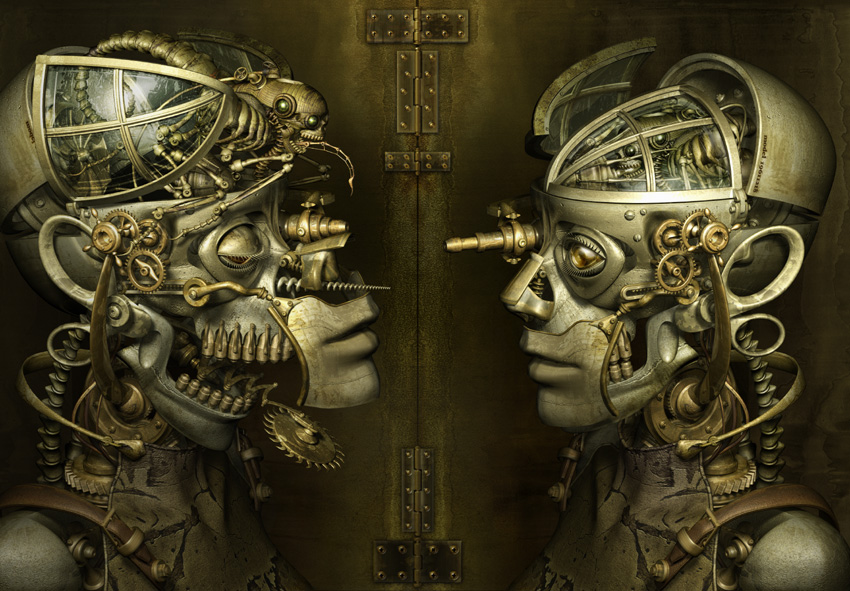
I gazed upon the machine cautiously through the stilted light, my eyes catching the glint of copper off its face. It smelled of oil and metal, and had eyes deader than a corpse’s.
“It’s…” I tripped over my words, and chewed at my lip. “What is it?”
My father’s eyes were alight with glee, and his upper lip curled into a smile. “An automaton, of course! But not like the ones you see in the shops, my dear, no… Those machines can hardly count their twos and threes. This, this creation here is capable of intelligent thought!”
I looked into its cold eyes again. “Really?”
Father pinched the end of his mustache with two fingers and twirled it. “A little enthusiasm would be welcomed,” he said. “I’ve been slaving over him for months!”
“Him?”
“Why, yes! I call him Cephas. Marvelous, isn’t it?”
Marvelous wasn’t quite the word that came to mind. The machine was tall in stature, with exposed gears at the neck and joints, and a ridiculous top hat perched upon its head that I assumed was my father’s attempt to make it look more human. Human. I would sooner compare it with a toaster.
But my father had always wanted a son, and he was an excellent clockmaker by trade. Perhaps this would offer him some solace in the fact that he got glued to a daughter who had no interest in befriending androids.
“Well! Let’s ignite him, shall we?” His eyes crinkled at the corners in elation, and he reached to flip a latch across its chest. It opened to reveal a small compartment with an assortment of buttons and knobs. “Would you like to do the honors, my sweet?”
I drew my lips into a thin line. “No, no, you do it.”
He pressed a red button, and at first nothing happened. Then a faint humming came from the inner mechanisms of its chest, and all at once the metal shuddered. A puff of dust escaped from the thing’s mouth, and a bluish glow bloomed in its empty eyes. I jumped back as its neck snapped to attention, and its head swiveled in its socket to behold my father and me.
My father clapped his hands. “Ah, do you see this, Parthena? It’s extraordinary!”
I took another step back, all the while keeping my eyes on the machine. “Yes, very extraordinary…”
Its icy sockets switched to me, and I felt my insides congeal. It was looking right into me, as if observing the deepest reaches of my consciousness. That’s…not possible… It’s a machine, it can’t be sentient…
“Greetings, Cephas!” my father exclaimed, grabbing hold of its mechanical arm so forcefully that he nearly knocked the thing over. “I’m your maker!” His voice was on the verge of delirium, and his eyes wild with an enthrallment that frightened me. The automaton’s head cranked towards my father, and that only caused him to squeal in excitement. “Oh, do say something!” he said. Then to me: “He can speak, you know. Can do anything! I won’t need your help around the shop so long as I have him. Cephas, you card, don’t be shy! We’re your friends here.”
I felt a bit of bile slopping up my throat, but I swallowed it and began to turn towards the stairs. “I’ll just be going, now…”
“Don’t be such a wet blanket, Parthena. Look, I think he’s about to speak…”
I looked back, just in time to see the machine’s jaw unhinge, and a few lifeless words tumble from its copper lips: “I want.”
My father blinked rapidly, and he clutched the side of the automaton. “What? What does that mean? What do you want, my son?”
With that, I could no longer stand to be in the room. I gathered up my dragging skirts and hurried up the stairs.
Days went by, and my father only grew more attached to Cephas. He no longer worked on his clocks, but spent hour after hour fawning over the mechanical creature, and boasting to anyone who would listen about its infinite database and unparalleled abilities. I avoided the thing as often as possible, but its eyes followed me everywhere, and it always seemed to be around every corner. It was in the workshop constructing perfect clocks with perfect pendulums and perfect glass casings; it was out in the shop charming customers with its perfect articulation and perfect wit and perfect salesmanship. It was perfect in every way.
But I hated the thing. Oh, my blood curdled and my fingers clenched whenever I saw it amble up the street, carrying the basket of groceries that Father had bid it to fetch. That used to be my job. I used to be the gopher. Now all I did was sit around, listening to the oohs and ahhs of entranced window shoppers as they admired its metallic sheen and sparkling personality. For God’s sake, it didn’t even have a personality. It was a toaster with a voice box. That was it.
And then Father began to speak of constructing more of them, ones that he could sell or rent off to make a bit of extra cash. He even jested about building enough to form a mechanical theatre troupe. When I told him he was being silly, he said, “Oh, but Cephas has an exquisite singing voice, Parthena. He lullabies me to sleep every night! I can bid him to do the same for you, if you’d like…” I scoffed the notion away, but his words did make me think. If he were able to organize an entertaining ensemble of automatons, then it wouldn’t be a stretch for him to assemble an army.
My father was a brilliant man with foolish notions. And I think that more than anything, that was what drove me away.
I left because I earned a scholarship that would be idiotic to pass on at a school in the country. At least, that’s what I told everyone. I really just wanted to get away, to go to a place where machines didn’t breathe down your neck and ribbons of smoke didn’t lace the sky. My father hardly noticed when I left. He was too busy in his workshop building another friend for Cephas. I didn’t care. Not anymore.
The country was a refreshing change of scene, and I was finally able to get the stench of oil and smoke out of my clothes. For years I studied, and over time my father and his mechanical doll faded into the back of my mind. He never wrote, asking after me and my studies. He never cared.
After two years, I decided to be the better person and travel home over holiday to visit him. A small part of me was glad to be returning home, and to see him again, but a more dominant portion of my brain was afraid at what I would find when I got there.
I boarded off the train at eleven o’ clock, the time when my father would be sending Cephas to prepare his lunch. My boots stabbed the cobblestone road as I headed up the street to his clockwork shop, and my mind reeled in anticipation. Would he have an army of automatons, as I feared? Or perhaps that theatre troupe he wanted so badly worked out, and he was on tour with a circus three countries over.
I rounded the corner, and stopped dead in my tracks. The windows to the shop were boarded up, and the scrawling script that once read “Orville’s Clockwork Emporium” was faded and missing letters. At first I didn’t move, I didn’t do anything…but stare and fret that my greatest fears were realized. He was dead. He was dead or lying in a ditch somewhere, dying.
No! I didn’t know that! My heart leapt into my mouth in a sudden strike of adrenaline, and I rushed over to a man who was sweeping his front porch. “Sir!” My voice was leadened with dread. “Excuse me, but do you know what happened to that clock shop?”
He looked at me with tired eyes, and said, “What clock shop?”
Surely, he can’t be genuine… “The clock shop across the road. Right there. With the boarded windows. I’m pointing to it?”That last sentence ended in a sort of question, because the man’s eyes offered no reassurance or familiarity.
“I’m sure I don’t know what you mean,” he said. “I’ve been here for seventeen years, and not once has there been a clock shop across the road.”
“No,” I breathed. “You’re lying. That’s not possible. My father worked there! He had an automaton!” I was practically shouting now, my voice harried and distant. “You must remember!”
The man gave me a leery glare, and shrunk back onto his doorstep. “I’ve already said, there is no such place!”
“No!” I spun away from him, and hurried back to my father’s abandoned shop to see if I could find an opening to peek through the windows. No such luck. The door was barred as well, and I was beginning to give in to defeat when I remembered- there was a back way. I tucked a strand of hair behind my ear, and ran off down the alleyway, coming around to the back of the shop, where the overflowing rubbish pails filled with rusted cogs and springs gathered in stinking heaps. I flew to the back door, and was about to toy with the knob when I heard a cranking, followed by, “I want…”
My head whisked around, and there, lying against the fence, was Cephas. He was rusted beyond repair, and one of his arms lay in pieces a meter away from him. His cog springs coiled out at random, and the gears around his jaw made an incessant ticking noise as they jammed together. But still, his eyes burned with a blue fire, and he looked up at me. “I want…”
“Where’s my father?” I demanded.
“He…he…he-he-he-he-heheheheheheeeee…” Cephas’ head began to jerk, and the light in his eyes blinked rapidly as he malfunctioned. I gave him a good kick in the side, and he snapped out of it.
“My father? What did you do to him?”
“My maker…” His voice was deeper than usual, and slurred like a drunkard’s. “…wanted to re-re-replace me…”
“What are you talking about?”
“He di-didn’t need me anymore. He didn’t want Ce-ce-cephas.”
“What did you do?”
“He wanted to re-replace m-me. Cephas wouldn’t let th-that happen.”
My heart sunk in understanding. “You did away with him.”
“Th-the beast lives on w-within the shop. Th-the beast lives on w-within the shop. N-ne-never go in. Cephas m-made sure no one ever g-goes in.”
“What beast? What do you mean?”
Cephas cocked his head, and a whistle squealed in his joints. “Cephas was t-too la-la-late.The automaton-ton-ton that Maker made is dange-danger-dange-”
“Dangerous?” The world around me went still, and it was only the machine. My father was gone…and it was this monster’s fault. But if it had stopped my father from bringing something even worse and more unnatural into the world…then I didn’t know what to think.
“Do not go in. No one go in. No one gooooo…” His voice become heavy and sloppy, and I knelt down beside him on the litter strewn ground.
“I want…” he garbled.
“I never liked you,” I said. “You replaced me.”
Then I flipped the latch on its chest, pressed the black button, and watched as its eyes died.
“Automaton” by Kazuhiko Nakamura
I’m a huge steampunk fan, and couldn’t help myself with this one! I wrote it all in one go, too, so there’s bound to be a few typos here and there.
It’s not often I brush such undisturbed air
than when the tumbling breeze does ruffle my hair,
or the bright set of night, all purple and green
paints the streaking of stars and the cosmos’ sheen.
For the hour when moon-chilled sand melds between toes and the pleading cicadas make themselves known
is the moment I muse how I remember
the savor of smoke and glow of bronze embers.
A sheet of still water sleeps under the sky, the bobbing of boats is a strange lullaby,
and I want to lie back and drift far away
by riding the the pale moon into a new day.
Starlight rains down on me, so near I might touch and preserve this instant with a single clutch,
from warm, trickling water to igneous skies
and toasted marshmallows with sand on the side.
This secluded patch of the world stitched by trees with its moaning loons and everlasting breeze
embodies my temple in each sound and smell,
from the whispering reeds to the sighing swells.
For it’s here where I shed the dins and the skins that toughen and bind me to societal whims,
and I know that sooner or later I’ll leave,
but I’ll never forget this midsummer’s eve.
I wrote this poem a while ago as a memory of my summers spent on Lake Winnipesaukee in New Hampshire. They were the most peaceful and perfect days out of the year, and I only wish that I still had time to go there. Lying in the sand by the water and hunting the purple sky for shooting stars was the highlight of my summer.
the light at the end of the lane
is a wicked illusion of sorts
with its siren screams and drawing dreams
it’s a trap with no end of distorts
the beam at the end of the bridge is a blinding delusion of thought
with its dashing doubts and shameful shouts
it’s a quagmire of senses forgot
the ray at the end of the road is a blatant evasion of truth
with ersatz ease of daunting degrees
it soon renders your senses uncouth
the gleam at the end of the gale is the harbinger of a new dawn
but its hopeless hope is but a hoax
for the eclipse is always foregone
While my true passion lies in novel writing, poetry has always held a unique place in my heart. This is just a little something I tapped out during my free time. It’s a bit word-heavy, but I think in the end it gets across what I’m trying to say.


 Stellular Scribe