Art is the same.

A short story inspired by The Things They Carried by Tim O’Brien. He’s truly an excellent writer. I recommend reading any of his work; The Things They Carried is probably the best book I’ve read in a long time. I tried my best to do his voice justice in this short piece about artists.


At 12 p.m. on April 10th, 2015 Monterey Grover popped the kickstand of his 1960 Schwinn Jaguar and set off down the narrow streets of Eugene, Oregon. A leather messenger bag carrying his Polaroid SZ-70 clattered against his leg as he pumped the pedals. The sky sulked in heavy sheets of gray, as if to make sure that the world below didn’t cling to any hopes of seeing the sun for another two months. 

The sun snickered over the balcony of Raul Castell’s high-rise apartment in San Francisco, California. Raul stood by the railing, drawing from a Toscano cigar and wondering how the dramatic arches of the city’s skyline would look on a suit jacket. He tapped out the cigar and turned to call for Eric.

Olivia Markowitz turned in her desk chair to call for her cat. When Sir Snouffles failed to round the corner, she glanced at her alarm clock and winced. Crap, it’s 3 o’ clock! I have class in thirty minutes! She bent back over her charcoal and tried to drown out the racket of the New York City streets with the trance of Rachmaninoff.

Crackpot kids. Senseless racket, Sean Reynolds thought sourly as he tucked the spray paint can into the front of his oversized jacket. He shrunk back into the shadows of the Philadelphia alleyway to wait for the gang of teenagers blasting rap music to move along. How was it that every time he picked out a new spot to paint something got in his way?

Every time Lien Phan returned to wash the stained glass windows, she found fresh smudges and grubby fingerprints. She sighed and set down the rag, turning to look at the wooden apples and grapes of Grinling Gibbons’ mantelpiece carvings that were on display across the open hall. Maybe today I’ll actually pick up a wood block, she thought. But it was only 2 o’ clock. She would be here cleaning windows at the Sugar Land, Texas Art Center and Gallery for another three hours still.


In the pockets of Olivia Markowitz’s oversized School of Visual Arts hoodie she carried stale cat treats that had never been thrown away. She didn’t even know why she held on to them; Sir Snouffles always spit them out every time she tried to coax him onto her lap. She carried pencils upon pencils upon pencils, HB and 9B and charcoal, chipped and chomped from long nights of nervous teeth chattering. She carried them in grocery bags and in coat pockets and in her hair, though she never seemed to be able to find them.

Raul Castell carried a tin of Toscano cigars to his studio every day in anticipation of client conferences that might need a little nudge in his favor. He liked the simplicity of the Toscano brand, the classic oily must of tobacco and tang of spice. He also knew that a fresh cigar paired with his diamond-cutting gaze could swing any interview his way. He carried a sketchbook of rich red leather, filled with drawings of evening gowns and feathered lapels and checkered pant cuffs.

Monterey Grover carried The Man, The Image & The World: A Retrospective by Henri Cartier-Bresson. It was the closest thing he had to a bible, and he liked to have it handy to whip out and prove his points during debates on the philosophy of photography — debates which he had surprisingly often. He carried a titanium tea mug that was virtually indestructible and impenetrable, and always had fresh bags of oolong and chai handy in his messenger bag pockets.

Lien Phan couldn’t fit much in her apron pockets, but she carried a stiff and square-shaped handbag in which she kept a small tub of vaseline, a flip phone, an unused pad of yellow paper, and a collection of tickets from fortune teller machines and cookies. They read phrases like “The beginning of wisdom is to desire it.” and “Your many hidden talents will become obvious to those around you.” She carried a small wood carving of a cross-legged Buddha that her grandfather had whittled for her when she was twelve years old. He always seemed to be smiling up at her, inviting her to admire his chubby chiseled fingers and toes.

Sean Reynolds carried a couple of cans of Rust-oleum Touch N Tone spray paint whenever he could scrape up $6.95 to buy them at the corner store. They always seemed to be running empty though, choking on their last fumes, and he never had quite the right colors. He carried in his Walgreens shopping bag a stick of chipped deodorant, a role of quarters, and a wallet with nothing in it except for his driver’s license from 1989. He liked to take out the license and imagine that he still had his steel Sedan and fresh, unlined face.


Lien carried a mountain of what-ifs between her shoulder blades. They started low with “What if I slept in this morning?” and peaked with “What if I was born in Hoi An, in the Kim Bong woodworking village? What if I grew up with Grandfather, with Ong Noi to teach me?” She carried the blind hope that one of her fortune tickets would come true, that a fresh start would put her on her way or her hidden talents would reveal themselves. She carried the fear that she would never be taken seriously in the presence of geniuses like Gibbons and Moriggl and the master woodworkers of Kim Bong. She carried the fear that she wouldn’t know where to start or how to start. She carried the fear that she’d never start.

Sean wore a worn Phillies cap that he knew would never collect enough change to guarantee his next meal. Weighing heavy on the back of his neck was the dread that he would turn a street corner and be caught in the crossfire of vying gangs, or that one morning he’d just drop on the sidewalk by a dumpster, left cold and forgotten and dead with the trash. He carried the tangled wires of panic and pride — pride in his work, in his signature that stamped back alley buildings and boxcar walls, that brought color and vibrancy to an otherwise grim and uninviting place. But panic in the price, in the worth, in the wondering — is this all there is to remember me by? Panic in the knowledge that he was alone with his art that everyone could see.

Raul carried rivalry, hot and bitter in the pit of his stomach. It fermented at all hours of the day and bubbled up whenever he opened a magazine and saw that his name wasn’t in the featured fashion column. He stubbornly lugged around his cutthroat passion and pressed it into pages of designs and long hours of stabbing and stitching around mannequins. But he also harbored vulnerabilities — the wanting to give only the finest in life to Eric, the conviction that nothing but the best was acceptable, the need to prove with Marsala wine and Persian carpets that he was thriving. Succeeding. Unbeatable.

Monterey carried carelessness, steaming in the lenses of his useless glasses. It clouded his 20/20 vision, causing him to fall back on the comfortable cushion of stability that his parents had built beneath him. He bore a name that he had given himself when he decided that ‘Michael’ was too mainstream. His evolving identity toted his aversion to the conventional. He sprouted a beard, tied his hair in a bun, and proclaimed to all 36 followers of his blog that he was going to look at the world more authentically. He carried cockiness, but he also carried passion — for the still, silence of photography that could capture loud and angry moments and manage to make them look peaceful. Monterey carried fear, the fear of being like everyone else, the fear of never establishing a self, the fear of being crushed by conformity.

Olivia liked to think that she didn’t carry anything but unpaid student loans and unanswered emails from her parents. But really, with each sleepless night and completed canvas she carved a new tally into her growing doubt. She hauled around the doubt that she would never be able to support herself on art alone, that the wide-scale, carefully detailed charcoal portraits she slaved over were really worth no more than the crappy doodles she did on her napkins at lunch. She hunched over the worry that her parents had been right all along — that art school was a mistake, that she would never hold a stable job, that in the end she was better off sticking to her napkin scribbles and going to some business school. Olivia carried uncertainty, and to a lesser extent, insecurity — because though she lived for the gruff grasp of charcoal on paper and feeling of all the parts of a portrait becoming a whole, she still bent her back to the fear that she would never be good enough.

They carried what-ifs and rivalry and carelessness, and panic and pride and sleepless nights. They carried contradictions, but they also carried the same fulfillment, the same gratification in creation. The same satisfaction in wanting to make something that was more than them.

We are different, but art is the same.


Raul Castell snuffed his cigar in an ash tray by the door and walked inside to the kitchen, where Eric stood over the stovetop frying eggs. He wore a simple ivory button-down, an early design of Raul’s from 2005. A shirt that Raul had sworn to never let see the light of day. But seeing it on Eric stirred something in him. It made him…happy. It made him want to go back, to the days when he designed not for maintaining his brand or stealing the runway — but for him and for his loved ones.

“Eggs? At noon?” Raul pressed.

Eric shrugged and scraped the contents of the pan onto a plate. “You looked like you were seething. Here’s to something soothing.”

The soothing draw of Rachmaninoff crowned on a mellow note, and Olivia Markowitz dropped her charcoal pencil, her fingers smudged black. It was too late to get to class now, but she had finished. Finally finished. Suddenly the grade didn’t mean anything, and she was left with just her and her smudged fingers and her art. A grin crept across her lips as she felt a familiar tail rub against her legs.

Blades of dewy grass rubbed against Monterey Grover’s legs as he knelt into the dirt, focusing his polaroid camera on the peeling paint of a park bench. Angle, zoom, and snap! He chuckled to himself as the picture processed — he liked it, he liked being alone in a park and taking pictures of friendless benches. He liked the solidarity of it; he liked having a piece of something that no one else cared about. He shook the photograph dry and waited to see whether or not the image would be worthy of his wall.

Lien Phan had spent a good five minutes staring at the wall displaying the Grinling Gibbons carvings before she remembered that she wasn’t getting paid by the hour. She returned to her window scrubbing, and thought that maybe she should give her mother a call and ask about the family back in Kim Bong. Maybe, just maybe, a trip home would find her the answers she needed. After all — “Your happiness is before you, not behind you!” her fortune of the day declared.

Sean Reynolds declared to himself that if the loitering teenagers didn’t move along then he would have to settle on finding a new spot. But where was he going to find a canvas hidden in plain sight that wasn’t infested with cops and pink-eyed dealers? He waited in the shadows and held his tongue, and eventually the lot of them moved on, their music shaking the dust in the air and pulsing through the ground to Sean’s feet. He advanced in on the cement wall and pulled his only two spray paint colors from his Walgreens bag: blue and black. As he shook up the first can, he glanced over each shoulder to make sure that the alley was good and empty. He could feel the energy in him, building up and sparkling at his fingertips, like firecrackers charged and busting to pop on the asphalt. A raw glee stirred the smoke in his belly, and he flicked the cap of the can to the ground.

Then he stepped back, saw his signature draped in sea-salt waves and midnight oil, and painted.


© 2015 Stellular Scribe
after — an original poem

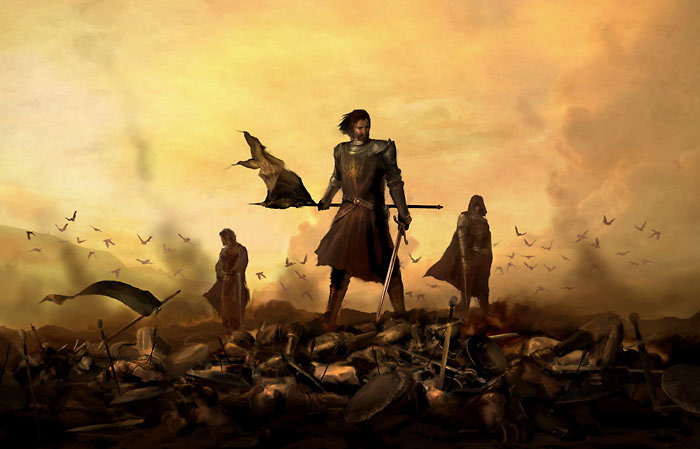
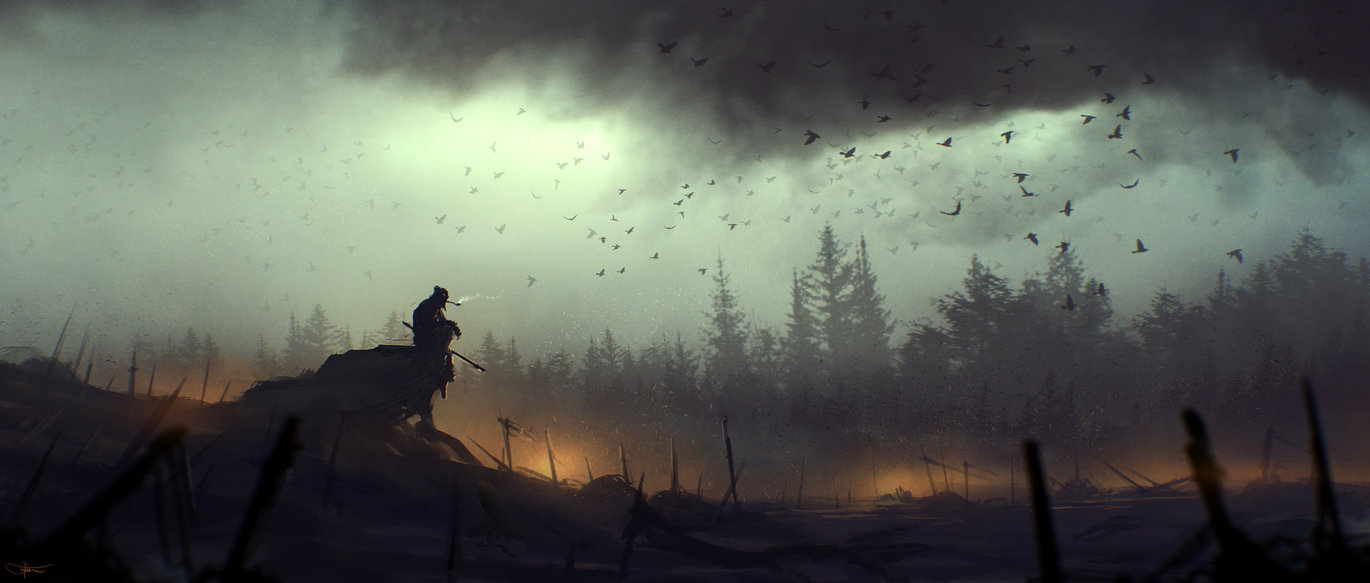
"After the Battle" by Daniel Tyka
After the Battle” by Daniel Tyka

after
smoke has settled
and the ground’s soaked up the red
after
night has tucked her blade
and left to break her bread
after
all the wanderers
have lined up foot to head
after
I have buried them
and laid them into bed

I am not my father’s son
though he may stir and grip his gun
I am not the army’s man
I left them long ‘fore I began
I am not a child of war
though hardened is my heart to gore

I am just the aftermath, you see.

after
words have crumbled
and there’s no one left to weep
after
time has torn apart
what we once swore to keep
after
all the wayfarers
have drifted fast asleep
after
I have wondered why
my song had not been reaped

© 2015 Stellular Scribe

Agony — an original poem

"Song of Battlefield" by Norimichi Tanaka
Song of Battlefield” by Norimichi Tanaka

What is worth our agony
if not the glory that will be
seized from stone in steely fort
and forged from molten foes cut short?

Is it worth our agony
to bloody limbs whilst bending knee
before a marble man who stands
upon the backs of his right hands?

Tell me, what is agony
but a dead man’s twisted plea
that drowns in rushing copper cries
until the slave’s last whimper dies?

Who is spared from agony?
I tell you, neither you or me —
for honor makes fools of us all,
bound by oath until we fall.

© 2015 Stellular Scribe

In Which I Find Myself In A Horror Movie

"the woods" by Simon Christen
the woods” by Simon Christen

There had always been a soft and slightly twisted part of my heart that loved the eerie, the delightfully creepy, and the suspenseful. It’s not like I had this deep-seated obsession with horror movies or an unhealthy fascination with the macabre — no, I mostly just liked the idea of something being so unearthly that it sent prickles up your spine or that something could be so bizarre and awe-inspiring that it filled you with a mixture of glee and cold, run-for-it panic.

Yesterday nature was confused as to whether it was ready to grow into its big boy March pants or revert into its temperamental Ice Age. This created a dilemma between the cold and warm air, and the rising tantrum resulted in fog. Lots and lots of pea-soup, fleece-lined, cotton-candy fog.

At 5:30 I locked up the house, got into my car, and began the commute to my music school, just like any other Wednesday. As I descended the hill out of my neighborhood, I sunk into a fog so thick that I could barely see the yellow line on the road. It was slow driving from there, and to relax myself, I turned on the radio.

It was the classical and jazz station — no harm there, right? Just some nice, soothing Bach or Rossini. Ha. Ha. Aha-ha-ha. When I turned up the volume, I was met with a chilling scream and crescendoing notes, all in discord, screeching against the ripple of thunder. My knuckles instantly tightened, and I hunched forward as I tried to make sense of what my ears were picking up. Turns out, the classical and jazz station was having a horror movie soundtrack special, complete with ghost wails and creaks and moaning waterphone cacophonies.

The mood in my little car on that winding, murky road changed abruptly. Suddenly I was hyper aware of the black silhouettes of every branch and bramble, each clawing finger that poked through the fog, straining towards my car. I could see the channels of mist that hugged the road, snaking in and out between the wheels, and the shadows that formed when the smoke lapsed and the moon loomed overhead.

A ghoulish sigh, the anxious spiccato of violins, a foghorn’s lament, the shatter of glass, the childish tinkle of a vibraphone… I drove sitting on the edge of my seat, willing myself to focus on the road ahead and not stray to the demon eyes that glowered from the trees above or the hulking shadow in the side mirror that stalked my car from behind.

I was thrilled and horrified and giddy and mortified. Oh my God! I’m in a horror movie, the enchanted part of me mused. Oh my God. I’m in a horror movie! the terror-stricken part of me cried. It continued like this up the rest of the road. This is so cool! They’re going to find my car abandoned in the woods. Wait till I tell everyone how creepy this was! Wait till everyone finds out I’m dead…

After about five minutes, the music switched to a Chopin piano concerto, and the legions of ghosts and living dead that marched on the woods around me melted away. I breathed a sigh of relief, and drove on.

© 2015 Stellular Scribe


True story.

Sparkplug — an original poem

"Steampunk weapon" by Luria-XXII
Steampunk weapon” by Luria-XXII

She was a sparkplug,
arms crossed, lips smug,
her roulette refined,
her fate stamped and signed —
diciest dame you’d ever find.

She was a renegade,
twisting tongues was her trade,
born with brass between her teeth,
a clockwork heart ticking beneath —
a queenly ace tucked up her sheath.

She was a sparkplug,
wayfarer whiskey was her drug,
with a corset pin
and a bottle of gin,
she redefined the depth of sin.

© 2015 Stellular Scribe

Traveler — an original poem

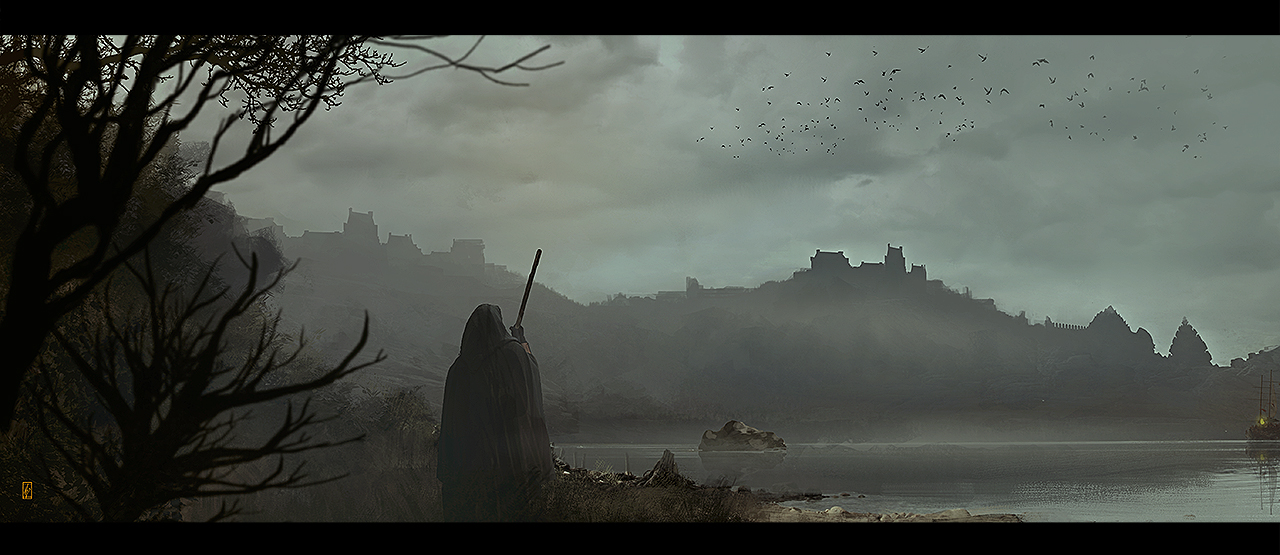
FERRYMAN by donmalo
FERRYMAN by donmalo

Restless is the wanderer,
inconstant are her itching feet
that cannot bide the ties of time
or ramble the well-travelled streets.
Nothing more than ‘fixed’ she fears,
and ‘settled’ stirs her skin with snakes —
adventure and the unknown steers
her into strange and thrilling stakes.
With each mountain matched and scaled
the lines across her map unravel,
for the wanderer can’t be nailed
in her life of constant travel.

© 2015 Stellular Scribe

Forsaken — an original poem

Christian Schoeler
Christian Schoeler

He was some forsaken singer,
rhymes lost, dead ringer
for that ol’ road-weary trope
of the dying antelope
that wonders, spilling strong,
why no one can hear his song.

He was some wrought-iron castaway,
steel-tamed yet fit for flay,
just a fat ol’ fish, hook in lip,
‘tween the old man’s knees, ’bout to slip,
wondering how the water could be
so cold above his cobalt sea.

He was some shriveled, paper poet,
mildewed months, wrinkles to show it,
resolved to ink sparrows into the sky,
to prove that words with wings could fly —
he wondered, tongue poised on the stars,
if time would ever stitch his scars.

© 2015 Stellular Scribe

Writing Playlists Part IV

Greetings, fellow scribes!

This compilation of writing mixes is especially dedicated to all those who are snowed in and have an unexpected and appreciated amount of free time to write (such as myself!). Here are five instrumental writing playlists designed to inspire your creativity!

I compiled the following three playlists with specific archetypes in mind. In the future I will make more character-based playlists.


Happy writing! 🙂

The Story Dealer — a short story

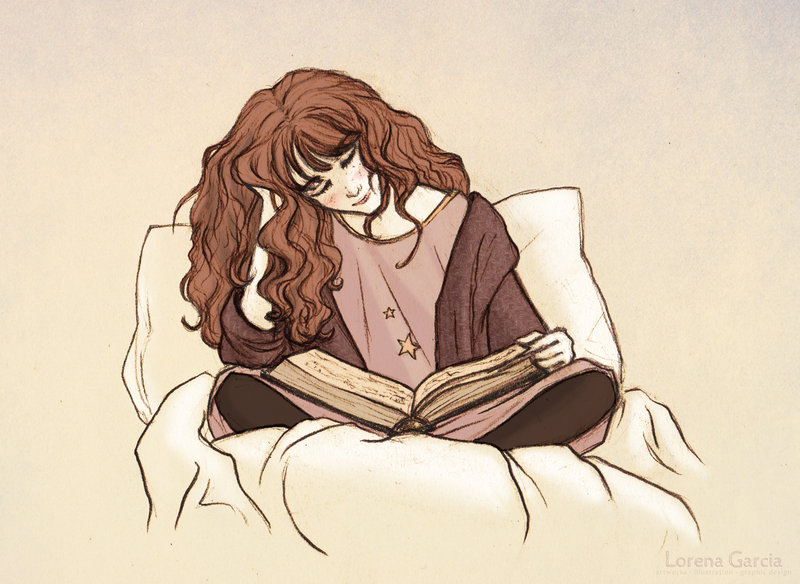
"Hermione Reading before Bed" by Lincevioleta
Hermione Reading before Bed” by Lincevioleta

I had just learned how to recite “The Pledge of Allegiance” in a perfect monotone when Olivia Briarly dealt her first story.

It was the second week of first grade, and the classroom smelled of sidewalk chalk and Mrs. Peter’s pumpkin spice perfume. We stood to attention, piggy fingers clamped over our chests, staring with fervor at the faded American flag over the door.

“…with liver tea and justice for frog.”

Mrs. Peters waited for a few straggling voices to mispronounce the last line before giving us permission to sit. On any other day, we would’ve collapsed into our chairs, overworked first graders that we were, and looked onward to her for the morning announcements.

But on this day, we collapsed into our chairs, and our attention was turned to the center of the room, where Olivia Briarly stood, palm pressed firmly against her blouse as if she were afraid that her heart would fall out.

Mrs. Peters tilted down her glasses. “Olivia, do you have a question?”

Olivia grinned. “Can I share a story with the class?”

“May I share a story,” Mrs. Peters corrected, “and no, now’s the time for announcements.” She turned to the chalkboard.

“But I just thought it up, and it’s really good.”

Mrs. Peters curled her lip, but quickly masked her annoyance with a tight smile. “You can tell your story at recess, Olivia. Now sit down.”

Olivia sat, but she jittered and squirmed and knocked her feet against the legs of her chair as if they were the iron bars of a cell. While Mrs. Peters spieled on about the lunch menu (salisbury steak with a side of Jell-O), I couldn’t take my eyes off the back of Olivia’s head. I snuck peeks at her from afar for the rest of the morning, and was so occupied wondering whether or not her story really was any good that I penned my sums right on the desktop.

After lunch, the clang of the recess bell summoned us to the playground, and the fastest kids dove into the swings like the wood-chips were lava. I noticed a small gathering of kids from my class amass over the hopscotch grid, and jogged over to see what was going on.

“Well, you have to tell us now. What’s it about?” a nasally-voiced kid said.

He spoke to Olivia, who stood tall in the middle, hands planted on her hips and bony elbows sticking out every which way. She wore purple and black striped stockings, and had thin lips that seemed to be created for the sole purpose of smirking.
“What will you give me in return?” she asked. “You can’t just expect me to tell it for nothin’. I’m offering valuable merchandise here.”

Fat Matt spit his gum into his palm. “You can have my Wrigley’s.”

She pulled her lips back over her teeth. “Ew…there’s a germ on that. I can’t get a germ!” She crossed her arms. “My story’s worth much more than some chewed gum.”

“What about this?”

I felt my cheeks bloom with color as ten pairs of eyes switched to me. In my outstretched hand was a sealed cup of raspberry Jell-O. I had stowed it away in my coat pocket with the goal to eat it under the slide, where I always got my best thoughts.

I was completely aware of the fact that Jell-O to a first grader was like wobbly, artificially-flavored gold. So naturally, a hunger that mirrored that of a hyena’s sadistic glee flashed across their eyes as I held the snack up. Olivia took a step closer, considering the scruffy, obviously-dressed-by-his-mother seven year old before her.

Then she flicked one of her sugar and spice grins, and snatched the cup from my hand.

“Ok! So once upon a time, there was this evil witch who cursed a poor family to live in a tissue box…”


In the second grade, we learned how to write in cursive, and Olivia mastered story dealing.

From sweet September till sweat-slick June of my seventh year, I could always count on finding Olivia in the same spot at recess: feet glued to the seven square of the hopscotch grid and hands tucked under her armpits. She wasn’t waiting for anyone; she would just stand there, and sometimes kids walking by would offer up goldfish packs or juice boxes or funny erasers in return for one of her stories, because everyone knew that Olivia told the best stories. She had a new tale to tell every day; I once overheard her narrate the life of a girl who could talk to bugs and went on the five o’ clock news to inform the world that bugs were, in fact, not gross. Then there was the story aptly titled Rockets in Spain, which was, as coincidence would have it, about sentient rockets in post-apocalyptic Spain.

By the second grade, my writing skills had refined to the point where I could print an e without the loop resembling a deflated balloon, and I had become astute at the art of experimental writing. But while I was struggling to piece letters together, Olivia was stringing up sentences.

The ‘news’ that Olivia was selling her written stories swallowed the student body faster than that nasty case of lice in kindergarten. I first took notice of the frenzy during lunch, when I went to empty my tray and saw a flash of color in the trash bin. Sandwiched between a chocolate milk carton and rumpled napkin was a pastel notebook page tucked into a neat square. I surveyed the area to make sure no one was looking, and then snatched it up into my pocket.

Two hours and a bellyful of undercooked pasta later, I unfolded the note in the shadow of the slide. Before me scrawled a page of beautifully misspelled words, and what I could only assume to be a ghost illustration in the bottom margin. It took about five minutes to discern the title (The Mysterious Swishing Sound), but I recognized Olivia’s signature right away. She had this feline way of writing: Os like stretching cat yawns, and lazy tail-like Ls.

I was about halfway through the haunting tale when the bell rang, and a teacher yelled at me to get out from under the slide. My shoes were untied and socks stuffed with wood-chips, but I didn’t care — my mind was somersaulting, dipping, twirling, splitting! Later I would realize that Olivia’s story, The Mysterious Swishing Sound, was just a grammatically flawed amalgam of every ghost story cliché to curse a page, but in that moment, it was nothing short of genius. How could she write like that? What kind of person could dream up stories like that? My mind performed gymnastics for the rest of the day.

The week before winter break, Sophie Wu promised Olivia all of the candy canes in her stocking if she could be written into the next story. Olivia sniffed a bargain, and whipped out three pages of the nail-biter Santa Claus is NOT Coming to Town within the day, in which the orphaned heroine, Sophie, saved Christmas from the cyborg elves. The next day she brought a crisp journal to school, and on the first page wrote Sophie’s name next to “a stockingful of candy canes.” She sat atop the monkey bars all through recess, bare feet dangling as she jotted down story requests.

The more Olivia wrote, the more people wanted to be written into her stories. And she delivered: Fat Matt was transformed into the gawkish knight of the Jellyfish Kingdom, Greg Bello assumed the persona of a transcontinental tortoise, Lily Sharma became a teenaged ghost on the hunt for the afterlife’s mall, and even the lunchtime custodian, Miss Maisie, was done over as a firefighting-winged-wonder-woman in The Adventures of A-Maise-ing Miss Maisie. As enlistment for character creation boomed, so did Olivia’s cult of readers. During one snowed in recess, I saw ten folded pastel papers on Gill Simon’s desk. Someway, somehow Olivia’s stories had become collectibles, and an unspoken competition sprung to see who could accumulate the most original works. I still hung on to The Mysterious Swishing Sound. That was my story. I had rescued it after all, hadn’t I?

Every writer, of course, has her critics. The technology teacher, Mrs. Wolf, once announced to the class that Olivia’s piece, The Gremlins Who Lived in the Computer Box, was unrealistic and un-researched. “Gremlins,” she spat (Mrs. Wolf suffered from hypersalivation), “are silly, inappropriate fictions, and don’t belong in computers. We’re here to learn about computers. Not gremlins.” Even the “gifted” counselor who came in once a week told Olivia that the main protagonist of The Green Gumdrop Man was “creative yet ultimately unlikable.” And who can forget her faithful flock of anti-fans? They were the sort of kids whose parents lied to them about Santa Claus’ existence, viewed reading as the most grueling of chores, and considered fart jokes the height of comedic enterprise. Olivia either didn’t notice or didn’t care when they snickered during her readings and left scraps of her stories in her desk, but my fists would roll into rocks whenever I saw them whisper venomously to each other.


I had always been just that kid — the observer, the extra, the background character. That kid who sat in the back of class, who sometimes knew the answer and sometimes didn’t, who never had anything particularly profound to say on any subject, who would much rather be busied by comic books and doodling musclebound super-villains than little league soccer or beginner violin. I wasn’t the kind of kid whose parents would write to counselors about, urging them to consider their child for the “gifted” program. I wasn’t the kind of kid who got rushes equivalent to that of sugar highs from succeeding or exceeding or even just completing. I was quite content to be unextraordinary.

I watched with quiet admiration as Olivia dug her roots into each person she met. I watched as she tossed her seeds across the playground, and I watched as she force fed them water and sunlight and steroids. Olivia didn’t just sprout. She erupted skyward, a rampant beanstalk bound for the heavens, and no cloud could overshadow her path.
Part of me wanted that untethered ability, that easy know-all and do-all flair that earned Olivia so many I-know-you’ll-be-rich-and-famous-one-day smiles from adults. But I couldn’t write a word that didn’t collapse beneath the sins of syntax and I had no stories to tell. What could I do? Midway through the second grade I had my first midlife crisis.


Third grade only fed Olivia’s fame as her writing gained mild coherency and consistency, while still clinging to her uncommon creativity. She dealt out stories by the genre, dabbling in sci-fi (The Cosmic Cactus), absurdist (When the Butter-People Attack), historical (The Real Witches of Salem, MA), and even poetry (Henry Hickle Hiber Hoo is Frightened of the Color Blue). Once, in the middle of a language arts test, she bust out in fluent tanka — a style that we would not be introduced to for another three years.

For Olivia, the third grade was a year of bountiful monkey erasers and enough Jell-O to jam her cubby for the winter. But in the fourth grade, something changed. Her fame fizzled.

There was this toy, moon shoes, that was really popular when I was seven. The chromatic advertisements touted them as “super-fun mini trampolines for your feet”, and everyone had to have a pair to strap to their sneakers. Those technicolor kangaroo-kids in that epilepsy-inducing commercial were just so gosh darn happy. For about a year, you couldn’t walk through a neighborhood without seeing kids trip-bouncing over curbs. But only for a year. Kids got bored, and maybe it was because moon shoes couldn’t get you more than a foot off the ground, or that nine out of ten kids suffered twisted ankles — or maybe they were just forgotten to collect dust in garages. Either way, moon shoes’ fame quickly fizzled, and dumpsters everywhere overflowed with broken rubber bands and kangaroo-kid dreams.

Olivia was the moon shoes of fourth grade.

Jealousy might’ve had something to do with it. I imagine that some people just got sick of hearing her trickle iambic pentameter into conversation, or listening to her explain exactly what iambic pentameter was. Suddenly having your name written into a story wasn’t so earth-shattering, and offering up your Oreos for a swashbuckling, time-traveling western didn’t have the same appeal as actually eating said Oreos. Kids got bored. And hungry.

Part of me was surprised at how willingly Olivia retreated from the limelight. Instead of standing over the hopscotch grid and chatting up prospective clients, she curled in the shade of the maple tree and lost herself in her notebook. Instead of interrupting the math teacher with propositions for penning his biography, she hunched over her desk, head low and pencil poised. I watched as her signature pastel papers all but vanished from desks and whiteboards and trash bins. I watched…but that’s all I did, watch. I was an observer, an extra. Like the guy who watched Godzilla destroy Tokyo from the safety of his television screen.

I thought maybe — if not for just a little bit in middle school — that Olivia and I were the same. Like me, she shied away from attention. Like me, she preferred to keep her true self safe beneath a sheet of water (or paper). I understood her. I got what it was like to love something but never be able to talk about it. I…

I don’t know why I thought of her this way. We weren’t even friends. She didn’t even know me.

God, writing this makes me sound like a creep.

Why do I act like I know her?


I’m thinking about how people can change but always stay the same.

I’m thinking about how people can do nothing but still mean something.

I’m thinking about talent and self-worth and being extraordinary.

I’m thinking about “The Pledge of Allegiance” and raspberry Jell-O.

I’m thinking about shadows and slides and being a mouse.

I’m thinking about delusion.


I always thought that I was just that kid — the observer, the extra, the background character. And maybe I am. I don’t know. But I think I’m ok with it.

Olivia was always the main character. Even in middle school and high school, even after she reverted and cast off her story-selling ways — she was still the girl who I watched haggle tales from my spot under the slide. Still the smirking, tanka-talking know-it-all. Still the story dealer.

I acted like I knew her. Because we were the same, weren’t we? I never talked to her, but I knew her. Or maybe that’s what most people call delusion.

When I see her sitting at the library desk, one hand twined into her hair and the other pinched around a pen, I suddenly don’t think of myself as a background character anymore. I am seventeen, and unextraordinary, but maybe for just a few minutes I can be a main character. So I get my guts together sit down across from her.

She bites the inside of her lip as she writes close, angular sentences that bleed into each other. I remember her feline way of writing in the second grade: loose and languid and floating on the page. Now her writing is sharp and hurried, as if she is trying to get the words out of her brain before they slip away forever.

I unfurl my hand over the table, dropping a folded square of purple pastel paper. Does she remember me? Did she ever even know me?

The tendons in her arm relax as she stops writing. Her eyes find mine first, quiet and confused, and then switch to the paper. I nudge it to the center of the table with the tip of my finger. The library buzzes with hushed voices and clacking keys, certainly not a malapropos environment to speak in — but I remain silent, urging her on with my gaze.

She tilts her head, her folded brow challenging my advance. After a few seconds of suspended library hum, she reaches for her pen.

“A deal.”

She looks back up. “A deal?”

Her eyes search mine for some sort of answer, but I give away nothing. With a soft sigh, she reaches for the paper, unfolding it slowly and holding the edges like an empty egg shell. It’s worn thin with thumbed down and frayed sides, but the words are clearer than the day they were penciled. As she reads through, she heaves a small gasp, tightening her grip on the paper before setting it down gently.

“What’s your proposition?” she finally asks, eyes still glued upon the pastel page.

I lean forward. “An old for a new.”

She releases a bubble of laughter. “You’re trading this crappy story for something new?”

“Hey, The Mysterious Swishing Sound is a classic.”

“But how do you even still have it? We didn’t exactly –” She falters off, but reclaims my gaze. “Something new? What do you mean, new?”

“Anything. Something you’ve already written. What you’re writing now. Something you hate. Something you love. I’ll read anything you write.”

She tucks a strand of hair behind her ear. “I…I haven’t done this since the third grade.”

“Done what? Story dealing?”

“Story dealing.” A thin smile stretches across her lips. “No, I guess not. I didn’t think anyone wanted to read my stuff. An old for a new, you ask?”

I nod. “So do we have a deal?”

She pauses, considering.

“Deal.”


© 2015 Stellular Scribe