
Writing Rounder Characters

While an intricate plot dripping with voice is essential to the integrity of your writing, a story just isn’t complete without well rounded characters.

No matter what genre you write, animated characters that readers can identify with are what drive the plot and keep audiences interested. But how does one go about breathing life into characterizations written on a page? While every writer has their own style and way of tackling depictions, there are a few crucial elements of character building that must be taken into account.

1. Give your a character a realistic and enticing background, but don’t drown them in it.

Everyone loves a good backstory, but sometimes its execution is tough to pull off. Backstories make characters more interesting; they give them a certain allure that can’t be achieved through laundry-list trait descriptions. In many ways, backstories make your characters more human (if your character isn’t a human, then that’s an entirely different kettle of fish). Don’t be afraid to get to the nitty gritty of what makes your character unique. Did something happen in their past that forced them to go in one direction over another? How is their story different from a more minor character’s?

While backstory is fun to write, beware of suffocating your reader in lengthy narratives about your character’s “ravaged past” and “tortured, orphaned soul”. There is such thing as too much backstory, or at least to the point where it takes up more of your writing than the actual plot.

2. Make a lasting impression.

You want to introduce your character with a bang. No one wants to read about Plain Paul who just happens to bump into the girl of his dreams while walking to work. Been there, read that. Not a dynamic first impression. And in this craft, first impressions are everything, because it’s what makes readers want more. Give them someone to care about, or not to care about. As long as they feel something about your character from the get-go.

3. Allow the reader to form and change their own opinions.

Once you’ve gotten the reader hooked with a dimensional character, throw them a curveball. As you develop your character, your reader must be able to develop their opinions. Maybe they start liking your character more. Maybe they grow a deep hatred for every word that passes your character’s lips. Change, no matter how beneficial or detrimental, is essential for well-rounded characters. Don’t fall into the flat trap, where everything your character does is premeditated and expected. Predictable characters are no fun to read or write about. Also, don’t be afraid to make your reader’s blood really boil by something your character does. As the genius of gut-wrenching character development, John Green, says,

I don’t know where people got the idea that characters in books are supposed to be likable. Books are not in the business of creating merely likeable characters with whom you can have some simple identification with. Books are in the business of creating great stories that make your brain go ahhbdgbdmerhbergurhbudgerbudbaaarr.

4. Paint them with flaws.

Complex character traits are key to making your writing pop off the page, and that includes writing your characters with imperfections. Simply put, perfect characters are boring. Who wants to read about the perfect love interest, with his perfectly chiseled jaw and perfect gentlemanly etiquette and perfect intellect? Maybe your character has a physical defect, or maybe he or she is especially jealous or competitive. Maybe their flaws are what make them all the more appealing.

When writing a novel a writer should create living people; people not characters. A character is a caricature.

-Ernest Hemingway, Death in the Afternoon

5. Give them a motivation. 

A character without motivation is a waste of space in a story. It would make no sense for Frodo to take the ring to Mordor if he hadn’t been bent on protecting the Shire, his friends, and all of Middle Earth. It would be pointless for Harry to seek Voldemort’s end if his parents had never been killed and he didn’t care about the well-being of his friends. This applies to protagonists and antagonists alike. If you give your character something to care about, you’ll give your reader something to care about.


Writing believable characters is one of the scariest and most rewarding parts of writing. There is nothing more satisfying than creating a well fleshed-out character, and in the end, it’s what will make your story stand out from the rest.
Hating Your Writing

Do you ever have those days where every word that passes your pen (or keys) is the most unpoetic, gelatinous heap of cliche’d garbage to curse a page? Well, if you used that description, you’re probably just hard on yourself. Ok, really hard on yourself. And believe it or not, this is an affliction that plagues even the most established of writers. People say that writers are conceited creatures, but we sure like to hate on our own craft.

I’ve known people who wouldn’t write another page until they had read over their previous one twenty times and had a beta reader edit it with a fat red marker. I’ve fallen into this trap many a times as well. I’d write one sentence, delete it, write another sentence, delete it, and so on until I had spent fifteen minutes staring at a blank page and cursing to the heavens about my ineptitude. The worst was when I was so stricken with inspiration, and knew exactly what I wanted to write about- but I would lie there like a dead fish, unable to recall how to function.

But, as author C.J. Cherryh says,

It is perfectly okay to write garbage—as long as you edit brilliantly.

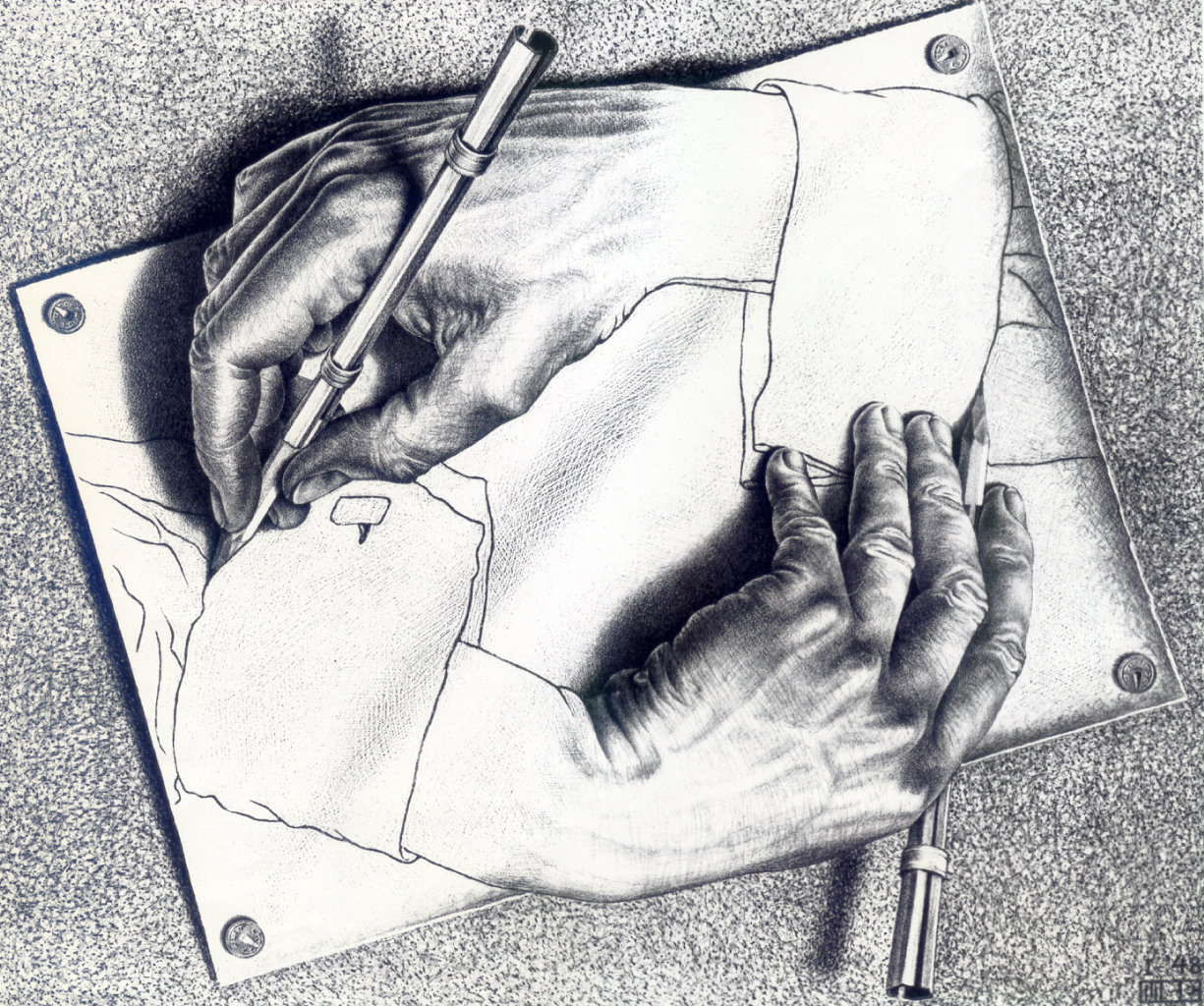
Drawing Hands
“Drawing Hands” by M.C. Escher

The key thing to remember when you write is to not look back. At least, not until you’re finished.

You may feel like every sentence is a struggle, that every word is choppy and unoriginal, that your very literary voice is flaking before your eyes. But no matter how cynical the storm seems, you must power on. Forget about the typos, the shaky dialogue and hokey metaphors. Don’t trouble your mind with stunted punctuation or minor plot holes. Just write.

Get it down. Take chances. It may be bad, but it’s the only way you can do anything really good.

– William Faulkner

When you’ve finished writing, take a step back. Walk away from the screen and busy yourself elsewhere. Take as long as you need. An hour. A day. A week. That way you can look upon your work with revitalized eyes, and a head clear of the biases that take root during the heat of writing. Then it’s finally time for the magic of editing.

Hey, no one ever said that writing was easy. From loathing the mocking glare of the blank page to blaming writer’s block on debilitating hand cramps, we suffer through a lot. But when all’s said and polished, the feeling you get from beholding your finished masterpiece is arguably the most irreplaceable in the world.

Planning vs. Planting

One does not simply sit down and write a book.

Chances are, if you’re a writer of fiction, you’ve heard the age old mantra of “Outline, organize, originate!” more than enough times. Many “how-to” and self help sites profess the ideology that if you want to write a book, you have have everything planned out. You have to know what happens when, who does what and how – all down to the last chapter.

And what do I say to this? If planning works for you, then great. If you like to have every detail of every subplot outlined before you flesh it out, then good for you.

But me? Not quite.

I’m a spur of the moment kind of writer. My stories bud randomly in the dark, musty corners of my brain, and are fueled by aromatic tea and just the right soundtrack. Inspiration tends to strike me at the most inconvenient moments: when my head’s about to sink into the pillow, as I’m getting in the car in the morning, while I’m trying to focus on work… I like to say that my last book was born with a color. For reasons beyond my understanding, an image of a scintillating color, lost in a sea of gray, marinated in my thoughts, and poof! The result was a 109,000 word novel that I wrote over the course of eight months. 

I can’t think of a better way to explain the difference between writers who plan and writers who plant than to go to the great George R. R. Martin himself.

In an audio interview with Gleekson, he said:

There are many different kinds of writers; I like to use the analogy of architects and gardeners. There are some writers who are architects, and they plan everything, they blueprint everything, and they know before they drive the first nail into the first board what the house is going to look like and where the closets are going to be, where the plumbing is going to run, and everything is figured out on the blueprints before they actually begin any work whatsoever. And then there are the gardeners who dig a little hole and drop a seed in and water it with their blood and see what comes up, and sort of shape it. They sort of know what seed they’ve planted- whether it’s an oak or an elm, or a horror story or a science fiction story, but they don’t know how big it’s going to be, or what shape it’s going to take. I am much more a gardener than an architect.

I think that in order to get the best experience out of writing, a writer must use a mix of planning and planting. They must let inspiration and passion guide their pen, but also pace themselves and know that they’re not writing themselves into a catastrophic plot hole. 

When I was in the crux of writing my book, I made myself write 2,000 words a day. It was brutal and trying and led to many sleep-deprived nights, but in the end it got me to my goal. I tried to plan some aspects of my story, but my characters usually had different ideas (which, as you will find, is common of characters). I may not have been the most organized in the way I went about writing, but my story felt like mine. And in the end, that’s what matters the most.

So what are you, a planner or a planter? An architect or a gardener?