If you pop by my blog often, you might notice that I write a lot of poetry in my spare time. Like, a lot. I think the current count is at well over one hundred poems in just this past year. Lord, whatever you do, do not go back and look at the early stuff. I was fifteen and angsty and I don’t want to talk about it.
With this is mind, it might also surprise you to know that poetry really isn’t my forte. I spend many more hours of the night writing novels, elaborate stories, and all sorts of whimsical fictions.
I picked up poetry by accident.
I’ve been working on my current novel for about a year and a half now (slow and steady wins the race — right?), and about mid-way through it I got to a scene where my main character was supposed to overhear a stranger sing a song that he recognized.
I did the only thing I could do, and whipped out the ol’ rhyming dictionary.
Oh, it was garbage (I can say that now), but something about that shambled-together, trite, melodramatic song opened my eyes to the potential of poetry. That song added an entirely new, visceral dimension to my story: atmosphere, fluidity, voice, movement.
My writing as a whole felt strengthened, so I made it a habit of jotting down poems everyday. As I became more comfortable, I experimented with more forms, styles, and meters. I abandoned a rhyme scheme; I rhymed religiously. I did away with punctuation and capitalization; I carefully molded each section of each sentence.
I know that to some people, poetry can seem scary. It feels like an entirely foreign, much more formidable beast than pure prose.
But I’m here to tell you that poetry really isn’t that different, and writing a little on the side might even help your fiction.
1. Capturing distinct sensations and imagery.
Poetry can be written for many different reasons — but it almost always seeks to convey some sort of image, be it concrete or abstract. Fiction in and of itself is the consolidation of diverse images to create a storyline.
The more poetry I write, the easier I find it to procure similes and metaphors to illustrate objects, meanings, and sensations. The more poetry I write, the more readily I reach into synecdoche, metonymy, and onomatopoeia to personify and paint scenes.
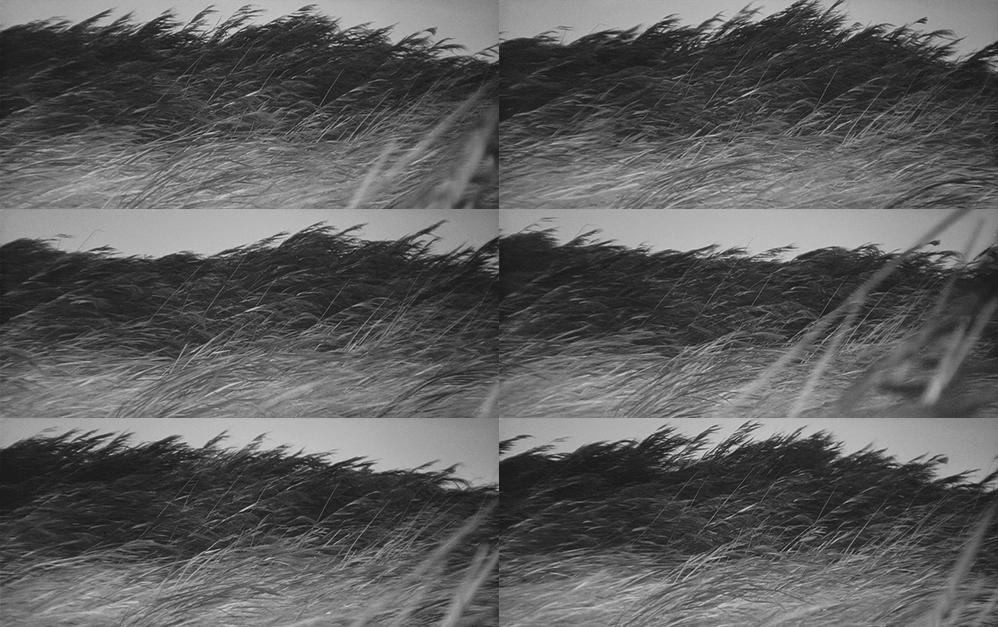
Poetry forces you to discover sharper, more powerful images. In fact, there was an entire movement in the early 2oth century where “imagists” considered the image to be the most important aspect of the written language. William Carlos Williams was well know for his simplistic yet highly evocative poetry. For example, here’s his 1923 poem, “The Red Wheelbarrow.”
so much depends
upon

a red wheel
barrow

glazed with rain
water

beside the white
chickens.
Now, take away the stanza structure and add some punctuation, and you’ve got a beautiful sentence that could strike color into any prose: “So much depends upon a red wheelbarrow, glazed with rainwater beside the white chickens.”
via
2. Perfecting pacing.
Whether you’re writing free verse or a meticulously metered sonnet, poetry is all about pacing. Every choice must be deliberate yet effortless — not too short, not too long, avoid superfluous words, and use just the right amount of description to get your image across.
When I write stories, I often have difficulty managing the pacing. Sometimes I’ll get so wrapped up in a plotline or a particular paragraph of characterization that the end result will be either too long, too dull, or too disjointed.
Poetry has taught me to let my writing breathe. Every word must have a purpose and serve to move the story forward.
via
3. Balancing different emotions.
I surprised myself with this one — I thought that I had my characters all figured out. I thought that they were well represented as emotionally complex individuals. I thought I was something special for creating such substantial individuals.
Yeah…then I started writing more poetry, and realized just how flat they actually fell.
I wrote poems — lots of small, un-extraordinary poems — that forced me to tap into emotions that I had never considered before. I truly experienced my characters through their eyes, and I delved into dark, unfathomable parts of their hearts and bright, mysterious places alike.
To give an example, here is a poem called “Wrecked” that I wrote over a year and a half ago:
They left me folded in sheets
of sand — wrapped in molding bandages
on the bed of the shore, with the surf
licking my frozen toes.
The gull who weeps for his friends
long dead is much like me — a nomad
with no name and no clan;
a roamer rejected by rose-ravished
words. Here I waste away,
repeatedly bitten by the wind’s sharpened
teeth — left to rot.
I discovered something intensely hopeless about the character this poem was written about. Something savage and vain, yet somehow wistful.
After this poem, I wrote that character anew — and for the better.
via
4. Writing with the natural rhythm of speech.
Rhythm is separate from pacing in that it deals with the fluidity, eloquence, and overall cadence of a piece of writing. In poetry, some semblance of rhythm is almost unavoidable. The same should be said for fiction and other forms of prose.
While you shouldn’t always write “how you talk”, you should always write with the rhythm of speech in mind. What I love about poetry is that it is intended to be read aloud, and therefore must have a certain “flow” about it that cooperates with the voice.
Simply put, the more poetry you write, the more fluently you will consider the world around you and your subject matter at hand. You’ll find your own unique rhythm!
via
5. Committing.
Maybe this is just me, but poetry actually inspired me to write more prose.
I got on a schedule of writing poetry, becoming overcome by a deep impulse to translate my newly realized emotions, sensations, and images into fiction, and buckling down to work on a story.
I’m by no means a poetry connoisseur. I’m also nowhere near being a fully functioning, organized member of society.
But somehow, poetry made me commit. And I will forever be grateful because of it.
via
So, what are your thoughts? Do you write poetry? Fiction? Do you find any meaningful connection between the two forms?
Thanks, and happy writing! 🙂

 Stellular Scribe